
Builder’s License vs. Contractor’s License: Key Differences Explained
Published on September 9, 2026 by Anna Coucke

These two certifications aren't interchangeable, even though people often use the terms that way. The one you hold determines what kind of projects you can legally take on, what you'll need to prove to get licensed, and how far your business can grow before you have to upgrade.
Since the rules shift by state, project type, and scope of work, understanding the difference upfront saves you from picking the wrong credential and having to backtrack later.
What Is a Builder?
A builder, sometimes called a residential builder depending on the region, is authorized to construct residential structures or handle major remodels on single-family homes, townhouses, and other dwellings. They cannot legally work on commercial buildings, institutional property, or industrial construction.
Their authority comes from the state in most cases, though a few, including New York, Texas, and Ohio, skip statewide licensing entirely and leave regulation to individual cities and counties.
“Handymen” or homeowners who perform minor residential repairs typically don’t need to register with the state if the project is below a specific dollar amount. But the numbers that trigger the requirement vary more than you'd expect. Arkansas requires a Residential Builder license once a project passes $2,000. Michigan sets the bar far lower, at just $600. Florida exempts casual or minor work under $2,500, though that exemption applies to any construction project in the state, not residential work specifically.
Builders don't get to self-perform everything. Electrical, plumbing, and HVAC work almost always fall outside a builder's training and require hiring a separate subcontractor, since those trades are typically regulated by their own boards.
Builder Requirements
What you need to prove depends on where you're applying. Some states lean heavily on prelicensing education, while others care more about documented hands-on experience, and plenty split the difference.
Applicants typically need to show that they understand both the technical and administrative sides of home construction, including:
- Construction knowledge and experience: Applicants may need to complete prelicensing education, gain hands-on experience, or do a combination of the two. They may also need to pass an examination covering topics like residential construction, codes, contracts, and business practices.
- Financial and regulatory readiness: Depending on the jurisdiction, builders may need to carry liability insurance, obtain a surety bond, or meet other financial-responsibility requirements. States or localities may also impose continuing education, renewal standards, or other requirements intended to keep licensees current with construction laws and practices.
Check the specific requirements for your state or locality before assuming a course built for one state will transfer to another.
What Is a Contractor?
A contractor license is a broader credential. It lets you contract, supervise, and perform construction work across both residential and commercial projects, and it can apply to general contractors as well as specialty contractors working in a single trade.
The project scope difference is substantial. A general contractor can take on commercial buildings, institutional structures, and public buildings. In many jurisdictions, they can legally oversee larger and more complex projects, both structurally and financially, than a home builder ever could.
Some trades still sit outside that authority. Roofing and siding often fall under the same general or specialty licensing system, but electrical, plumbing, and HVAC work almost never do. Most states regulate those three trades separately rather than folding them into the general contractor's classification.
Contractor Requirements
Contractor qualifications vary by jurisdiction and by classification, especially in states that separate general, building, residential, and specialty contractors into distinct types.
- Experience and examinations: Documented experience is standard, and some local regulators add business, law, or trade exams tied to the specific classification you're applying for.
- Financial, insurance, and bonding: Depending on the credential, you may need to show financial responsibility, carry workers' compensation coverage, or secure a surety bond. Several areas, including North Carolina, also set working-capital or net-worth minimums that determine how large a project you're allowed to take on.
- Company-level qualification: If the license is issued to a business entity rather than an individual, the company usually has to designate a qualifying individual whose experience and exam results satisfy the state on the business's behalf.
For contractors working across multiple states, the National Association of State Contractors Licensing Agencies (NASCLA) offers an accredited exam that more than a dozen state licensing boards accept in place of their own trade exam. Passing it once can simplify getting licensed in additional states as a business expands.
How They Compare
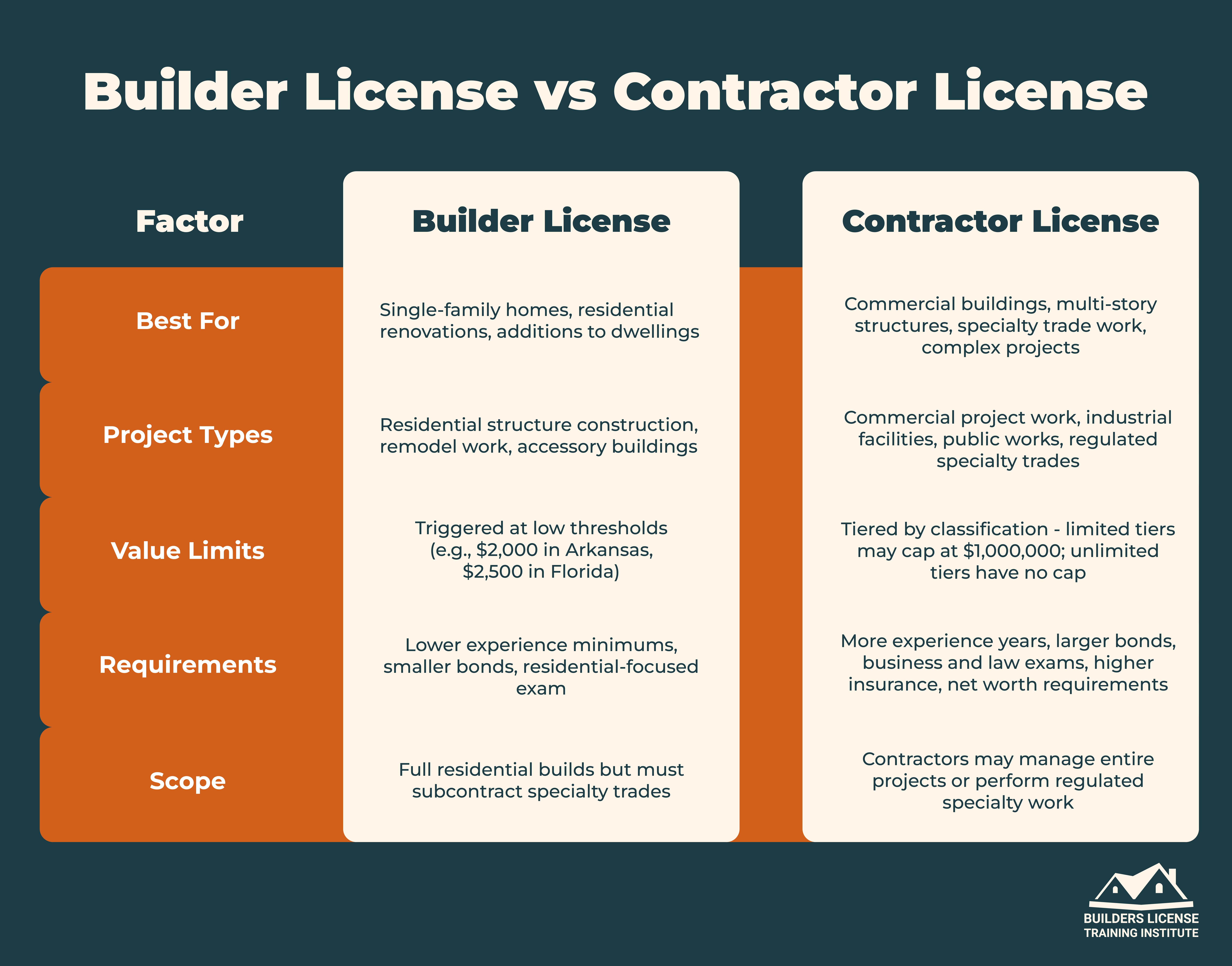
Builder licenses fit professionals who want to stay focused on building and renovating homes. Contractor licenses are better for those who need room to move between commercial and residential work, or who want to specialize in a regulated trade without being boxed into one project type forever.
Plenty of successful contractors begin with a builder's license, build a track record, and make the change once they're ready to take on commercial work or larger projects. Some states, like Georgia, even structure their licensing tiers specifically to support that path.
Whichever route fits you, go in prepared. Builders License Training Institute offers state-approved prelicensing education and exam prep built around your state's specific requirements. Learn how to get your license and start building your career.